

+86-571-63780050
+86-18918137728
19941084290
Content
- 1 Start With the Exhibit and the Case
- 2 Museum Display Case Glass Specification Checklist
- 3 1. Low-Iron Glass and Color Neutrality
- 4 2. Low-Reflection Coating Requirements
- 5 3. Laminated, Tempered or Heat-Strengthened Glass
- 6 4. Thickness, Panel Size and Deflection
- 7 5. UV Protection and Collection Care
- 8 6. Coating, Edges, Sealants and Cleaning
- 9 7. Documents to Request Before Production
- 10 8. Museum Glass RFQ Checklist
- 11 Final Selection Advice
Specifying museum display case glass is not simply a choice between “clear” and “anti-reflective.” The glazing must support visibility, object protection, security, sealing and long-term maintenance at the same time. This guide gives museum professionals, showcase manufacturers, architects and project buyers a practical framework for preparing museum display case glass specifications.
Start With the Exhibit and the Case
Before choosing a glass build-up, record the exhibit sensitivity, case type, panel dimensions, support conditions, visitor distance, lighting arrangement, security target and destination-market requirements. A freestanding case for robust objects may need a different solution from a large wall case protecting paper, textiles or historic documents.
Museum Display Case Glass Specification Checklist
| Specification item | What the buyer should confirm |
|---|---|
| Glass substrate | Standard clear or low-iron glass, selected according to color neutrality and panel thickness. |
| Optical performance | Visible light transmission, reflectance per surface, haze and any residual reflected color. |
| Safety construction | Monolithic, tempered, heat-strengthened or laminated construction based on risk assessment. |
| Interlayer | Type, thickness, optical quality, UV performance and compatibility with edge materials and sealants. |
| Panel dimensions | Finished size, tolerances, edge finish, holes, notches, angles and support method. |
| Structural behavior | Deflection limits, design loads and the effect of panel size on showcase sealing. |
| Coating surfaces | Number and orientation of coated surfaces, handling rules and cleaning requirements. |
| Documentation | Technical data, test reports, approved sample, inspection criteria and packing details. |
1. Low-Iron Glass and Color Neutrality
Standard float glass can show a green tint, especially at exposed edges and in thicker laminated constructions. Low-iron glass reduces that color shift and is commonly selected where faithful color rendering is important. It is particularly useful for jewelry, artwork, documents and objects viewed through more than one glazed surface.
Low-iron glass improves clarity, but it is not automatically low-reflective. The substrate and the optical coating perform different jobs and should be specified separately.
2. Low-Reflection Coating Requirements
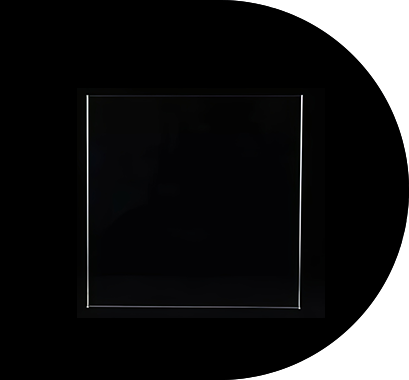
A low-reflection coating reduces distracting images of visitors, lights and the gallery interior. Buyers should request measured values rather than relying only on terms such as “invisible glass” or “museum glass.” The project specification should state the measurement method, angle of incidence, number of coated surfaces and the acceptable residual reflection color.
Lighting and geometry still matter. A physical sample or full-size mock-up under the intended lighting is one of the most useful approval steps before production.
3. Laminated, Tempered or Heat-Strengthened Glass
Glass type should follow the case risk assessment. Laminated glass can retain fragments after breakage and can support security and UV-control requirements through the selected interlayer. Tempered glass has different breakage behavior and may be appropriate where human-impact safety is the primary concern. Heat-strengthened plies may be selected when lower optical distortion is important, subject to the project design.
No construction should be specified from a generic chart alone. Panel size, edge support, openings, loads and local standards must be reviewed by the responsible designer or engineer.
4. Thickness, Panel Size and Deflection
Thickness is not determined only by the height and width of the panel. Aspect ratio, support condition, glass build-up, design load and allowable deflection all influence the result. Excessive bending can affect alignment, seals and the internal conservation environment of a large display case.
For projects where deflection and sealing are critical, review our anti-deformation low-reflection glass and discuss the complete panel and case design with the technical team.
5. UV Protection and Collection Care
UV control should be defined with a wavelength range and a test report. The result may depend on the glass substrate, coating and interlayer. Sensitive objects can also be damaged by visible light and heat, so glazing must be coordinated with illumination level, exposure time, temperature, relative humidity and the museum’s conservation plan.
A percentage without a stated test range is not enough for technical procurement. Request the spectral data relevant to the collection and verify that the tested build-up matches the product being ordered.
6. Coating, Edges, Sealants and Cleaning
Optical coatings require clear identification and careful handling. The drawing and packing list should identify coated surfaces and any restrictions on bonding, gaskets or cleaning chemicals. Exposed laminated edges need protection from incompatible sealants, persistent moisture and unsuitable site storage.
Specify polished or ground edges where they are visible, define corner treatment, and confirm tolerances before production. Cleaning instructions should be handed to the installer and the museum operations team.
7. Documents to Request Before Production
- Confirmed glass build-up and finished dimensions
- Optical and UV test data for the proposed construction
- Relevant safety or impact test reports
- Edge, hole, notch and coating-surface drawings
- Approved physical sample or mock-up record
- Visual inspection criteria and acceptance conditions
- Packing, transport, storage and cleaning instructions
You can review SCSG’s production process and quality information when preparing supplier qualification documents.
8. Museum Glass RFQ Checklist
To receive a useful quotation, send the supplier the following information:
- Application and case type
- Panel sizes, quantities and drawings
- Required glass construction or performance target
- Optical, UV, safety and security requirements
- Edge work, holes, notches and bonding details
- Destination country and required standards
- Requested samples, reports and delivery schedule
Final Selection Advice
A strong museum display case glass specification connects visual performance with safety, conservation, structure and installation. Define measurable requirements, approve a representative sample and make sure the test documents match the final glass build-up. This approach reduces ambiguity during quotation and lowers the risk of costly replacement after installation.
For a project-specific recommendation, contact Hangzhou SCSG Glass Technology with your drawings, panel dimensions, quantity, destination and performance requirements.
